
'The origins of the model of planned economic development adopted by independent India was a direct consequence of the war.' 'The war provided an opportunity for groups at the margins of Indian society to find new avenues for mobility.' 'The war also led to the emergence of India as a major Asian power and set the stage for it to play a wider role in international politics.'
'According to me, her finest hour was in 1983-1984 when she neutralised a combined US-Pakistan-British conspiracy to Balkanise India by creating an independent Sikh State of Khalistan,' says Colonel Anil A Athale (retd). A special assessment of Indira Gandhi on her centenary.

'It is not a matter of fixing the military problem up there in the Himalayas and the retreat of the two militaries.' 'India has to find a way to correct the racist and very patronising views of India in the Chinese mind.'

'The Army must always be balanced in response.' 'Rabble rousers will demand that it be given a free hand against anti-national elements in the streets. That is exactly what the adversaries want.' 'Burning the Kashmir Valley through the summer is their desire; the Army will never contribute to enhancing their aim,' says Lieutenant General Syed Ata Hasnain (retd), who served as the General Officer Commanding 15 Corps in Kashmir.

Navy chief Adm. Sunil Lanba said that by 2050, India will have 200 ships, 500 aircraft.
The average Indian soldier remains as hardy as before but he is certainly confused with the pace of change occurring all around him. It is here that the leaders -- the officers -- will have to adapt themselves to the new reality, says Nikhil Gokhale

India's military prowess and multi-hued images of the country's rich cultural diversity and achievements in various fields were on display at the majestic Rajpath on Tuesday during 67th Republic Day parade which was graced by French President Francois Hollande as the chief guest.

Prime Minister Modi felt there were too many silos with no arrangement to take a comprehensive view on national security. The PM has entrusted NSA Ajit Doval to evolve a comprehensive roadmap and get it implemented, reveals Nitin Gokhale, Editor-in-Chief, Strategic News International.
The navy wants to spend Rs 40,000 crore on INS Vishal, a choice the army and air force oppose. This is as much about turf as about funding. explains Ajai Shukla.
.jpg)
Beating of war drums, would further accord primacy to the army in Pakistan. A better approach would be to continue the talks for normalisation of trade relations, while giving the Indian forces autonomy to strike at militant camps across the LoC, says Alok Bansal

'We rarely choose to fight when the threat is still a nascent threat. When we do fight, we fight when the invaders reach Panipat and are preparing to knock on the gates of Delhi.'
In fact, given the current tensions and massed troops on both sides, there is a danger that the LAC will become more like the Line of Control with Pakistan, a heavily fortified and strongly defended border where weapon fire exchanges regularly occur. Indeed, Stratfor Worldview research has listed a sharp increase in new Chinese facilities along the LAC in 2019-20.

Tawang wears its history -- and also its present -- with ease. The flourishing town, with restaurants selling everything from noodles to dosas and locals returning home to new business prospects, shows little sign of the tension building up at the border about 40 km away to the north.
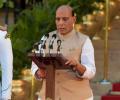
The new minister must commit himself to supporting long-term defence plans or else defence modernisation will continue to lag and the growing military capabilities gap with China will assume ominous proportions, warns Brigadier Gurmeet Kanwal (retd).

'The military aim in a future conflict, if it can't be avoided, should be to cause maximum damage to the adversary's war waging capability and capture limited amount of territory as a bargaining counter,' says Brigadier Gurmeet Kanwal (retd).
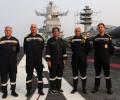
'At 1.58% of GDP, the defence budget is one of the lowest since the Chinese aggression of 1962.' 'The government of the day has lost sight of the fact that defence of the country is as important as its growth,' says Brigadier S K Chatterji (retd).

'We have not seen even during Vajpayee's time what Modi and the BJP has adopted now.'

'Wing Commander Abhinandan would not have even worried if he was going to cross the LoC or not because he was not going to let go of a shot.'
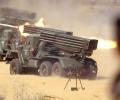
'Will it lead to a full-scale war? I doubt it.' 'But I do think there will be some kind of limited conflict.'

'There are retaliatory incursions, ambushes, captures and killings by Indian forces along the 700 km border; alleged spies are caught on both sides, then mutually traded as pawns; envoys are summoned in both capitals to be routinely given dressing downs.' 'And there is always a handy courier pigeon, like Sajjan Jindal, sent over to test the troubled waters,' says Sunil Sethi.
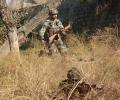
'Jihadi outfits backed by the ISI are now prepared to attack targets not just in J&K, but also in Punjab. This signals an escalation in the range and scope of cross-border terrorism, which cannot be ignored,' says Ambassador G Parthasarthy, former high commissioner to Pakistan.

Outgoing Army Chief Gen Bikram Singh on Thursday said that India had given a befitting reply to Pakistan after the beheading of an Indian soldier by Pakistani troops in 2013 along the Line of Control even as he did not rule out the possibility of skirmishes on the western front in future.

He also said it was important that even during the difficult moments of this "crisis" India has been communicating and engaging with China.
The MEA said it was the Chinese side that recently undertakook activities hindering India's normal patrols in the areas.

The navy finds itself fighting for relevance, with navy planners lamenting that its share of the budget has dropped dramatically.
The PM's vision of a lean, agile, mobile and technology driven force requires more than 1.7 percent of GDP that it now gets.
'A couple of Pulwamas will bring the two nations to war and it will be limited to J&K itself.'
In the lead up to this week Indo-US Strategic Dialogue, for which United States Secretary of State, John Kerry, will be coming to Delhi, the Indo-US defence engagement is even more intense than usual.

India was fooled into believing that Communist China wanted a 'negotiated' settlement with the Tibetans; it was never the case, says Claude Arpi.

'A veiled secret of India's defence and strategic culture is the lack of a serious interest in them by the political class. The Indian National Defence University would fill this void,' feels Lieutenant General Anil Chait (retd).

'India has ramped up infrastructure on its side, so the Chinese military is finding Indian soldiers in locations where they are not used to seeing an Indian footprint,' points out Harsh V Pant.

In a subtle show of strength to China, the Indian Air Force on Tuesday landed its C-130J Super Hercules transport plane at the world's highest and recently-activated Daulat Beg Oldie airstrip in Ladakh near the Line of Actual Control, the scene of a stand-off with Chinese troops in April.

Swaraj expressed satisfaction over the agenda of the inaugural dialogue while giving the details of the deliberations.

'After a strategic pause though, Beijing will revive its policy of slowly creeping towards acquiring sovereignty over the South China Sea.'

Defence Minister Manohar Parrikar on Monday mooted the idea of raising an all women battalion and stationing of women on warships besides opening the doors of the National Defence Academy and Sainik schools for them.

Pakistan perceives that if it had declared Gilgit-Baltistan, PoK or both, which are only a part of the territories of J&K, as legitimate provinces of Pakistan it would weaken its case for the entire J&K and lead to legal complications, observes Lieutenant General Syed Ata Hasnain (retd).

By weakening Sharif, the corps commanders could have a final say in important matters like relations with India, dealing with Taliban militants, interacting with Americans and once again achieving strategic depth in post-NATO Afghanistan. Which is why they may be behind the unrest in Pakistan led by Imran Khan and Dr Tahirul Qadri, says Shahzad Raza.

If the initial analysis of this YJ-21 is correct, then China becomes the first country in the world to operationally field such a missile from a naval vessel.

Girls in the Kashmir valley hurling defiance at the security forces will detract from the legitimacy of India's response and its standing in the world, says Ajai Shukla.

'Ajit Doval has done a splendid job in handling the Pathankot attack and certainly helped save heavy destruction of critical air force assets,' says Abhay Jere.
 © 2026 Rediff.com - Advertise with us - Disclaimer - Privacy Policy - Sitemap - Feedback - About us - Terms of use - Grievances